


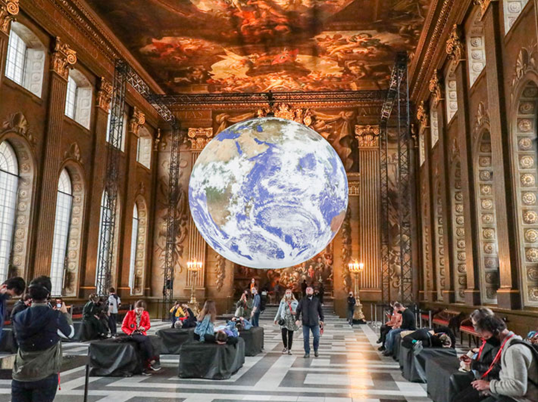
Gaia is a touring artwork by UK artist Luke Jerram and will be installed in Sherborne Abbey from 29th August 2025 until 11th September 2025 and will be available for all to see for free, along with a specially curated, earth-inspired programme of ticketed events.
Measuring seven metres in diameter, Gaia features 120dpi detailed NASA imagery of the Earth’s surface*. The artwork
provides the opportunity to see our planet on this scale, floating in three-dimensions.
The installation creates a sense of the Overview Effect, which was first described by author Frank White in 1987.
Common features of the experience for astronauts are a feeling of awe for the planet, a profound understanding of the
interconnection of all life, and a renewed sense of responsibility for taking care of the environment.
The artwork also acts as a mirror to major events in society. The artwork may provide the viewer with a new perspective of our place on the planet; a sense that societies of the Earth are all interconnected and that we have a responsibility toward one another. After experiencing lockdown during the Covid pandemic, there has been a renewed respect for nature.
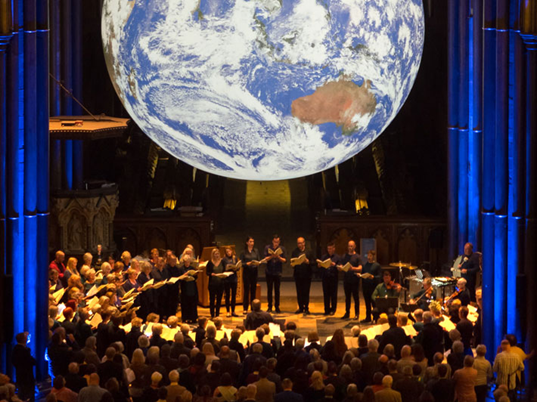
A specially made surround-sound composition by BAFTA award winning Composer Dan Jones is played alongside the sculpture. In Greek Mythology Gaia is the personification of the Earth.
Gaia has been created in partnership with the Natural Environment Research Council (NERC), Bluedot and the UK Association for Science and Discovery Centres. With supporting partners Culture Liverpool and Liverpool Cathedral.
*The imagery for the artwork has been compiled from the NASA Visible Earth series.
The artwork is 1.8 million times smaller than the real Earth with each centimetre of the internally lit sculpture describing 18kmof the Earth’s surface. By standing 211m away from the artwork, the public will be able to see the Earth as it appears from the Moon.
Unlike the moon, which we have been gazing at for millennia, the first time humankind got to see the Earth in its entirety as a blue marble floating in space was in 1972 with NASA’s Apollo 17 mission. At this moment, our perception and understanding of our planet changed forever. Hanging in the black emptiness of space the Earth seems isolated, a precious and fragile island of life. From a distance, the Earth is just a pale blue dot.
Over its lifetime, Gaia will be presented in a number of different ways both indoors and outdoors. Whether the artwork is
presented in a museum, science centre or parkland, the experience and interpretation of the artwork will change.